
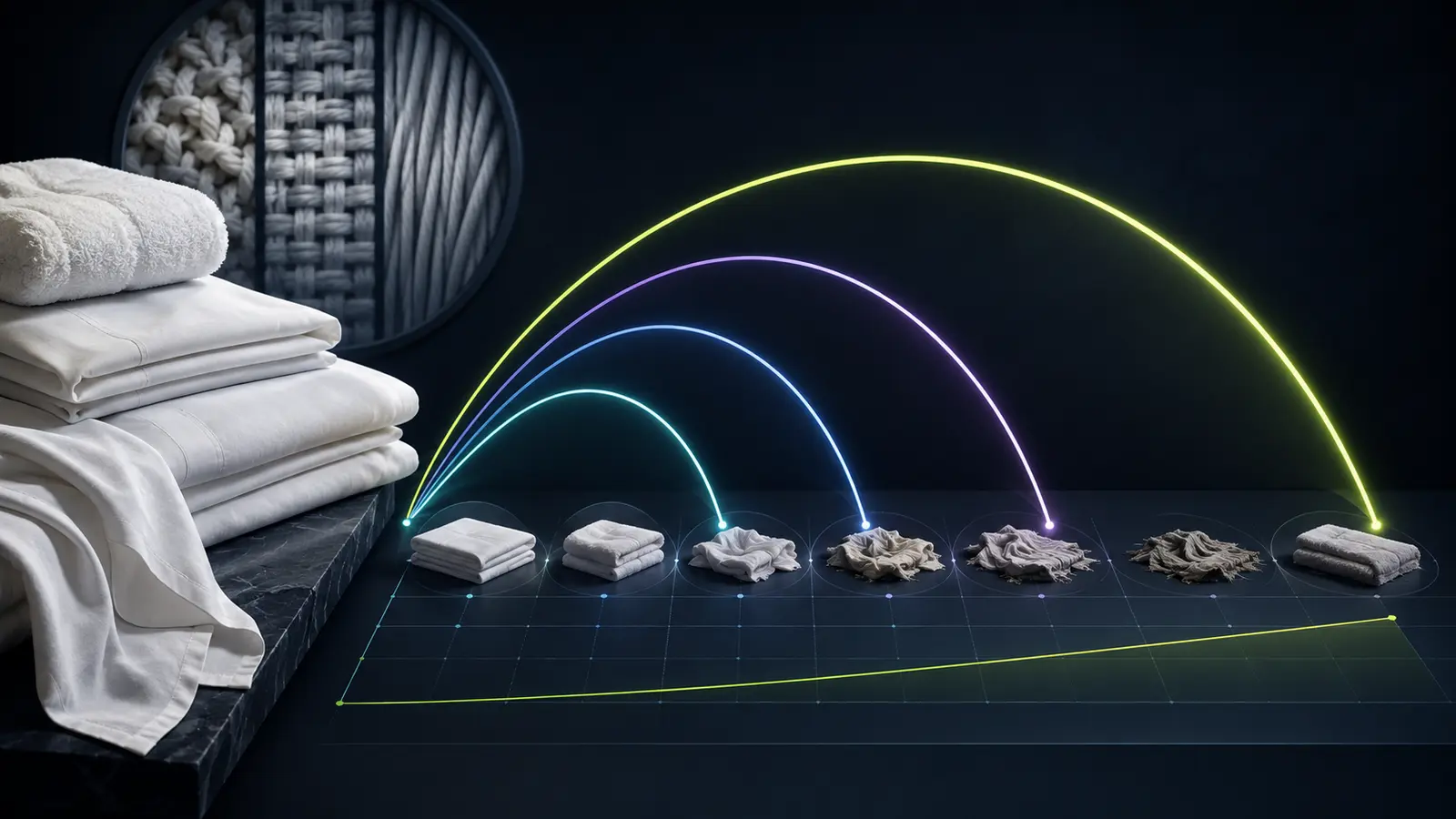
Purchase price and cost per use
When hotels compare textiles, purchase price is naturally one of the first numbers on the table. If one towel costs €8 and another costs €10, the first is cheaper. Or at least it is cheaper to buy. Whether it is cheaper to use is a rather different question. Imagine the €8 towel survives 80 laundry cycles before it has to be withdrawn, while the €10 towel remains acceptable for 140 cycles. The more expensive towel has actually cost considerably less for every use the hotel obtained from it.
This is hardly a revolutionary concept. Procurement professionals routinely consider total cost of ownership when evaluating equipment, vehicles or technology. With textiles, however, doing the same calculation has historically been difficult for one simple reason: hotels rarely know how many times an individual article has actually been used or washed. So purchasing decisions tend to rely on specifications, supplier claims, sample testing, previous experience and price.
Expected life and useful life
All of those are useful. But none tells us what subsequently happened in the real operation. And textile lifespan is affected by considerably more than manufacturing quality. Laundry chemistry matters. Temperature matters. Finishing processes matter. How an article is handled matters. Different hotels may use the same product differently. A towel at a resort may experience a very different life from the same towel in a city hotel.
There is also an important distinction between theoretical lifespan and useful lifespan. A manufacturer may reasonably expect a textile to survive a certain number of washes. But an article that disappears after 40 cycles has not delivered 120 cycles of value simply because it was capable of doing so. Nor has one that sits unused in a storeroom for two years before a specification change makes it obsolete.
Durability matters in rental too
The hotel pays for the life it actually obtains. This becomes particularly interesting when textiles are rented. It would be easy to assume that textile durability is then exclusively the laundry’s concern because the laundry owns the article and replaces it. But again, ownership and economic interest are not necessarily the same thing.
The cost of textile replacement is part of the cost structure behind the rental service. A towel that needs replacing after 60 cycles is more expensive to provide than one delivering 120. Over time, those economics inevitably influence rental prices, contract negotiations or the quality of the product a supplier can economically provide. The hotel therefore has an interest in textile lifespan even when it never purchases the textile itself.
Compare measured performance
More importantly, reliable lifecycle information could improve the conversation between hotels, laundries and manufacturers. Instead of saying that one towel seems to last longer than another, we could ask how many useful cycles each product actually achieves. Instead of assuming premature wear is a textile-quality problem, we could investigate whether the same article performs differently across laundries. Procurement could compare suppliers not only on price per piece, but on cost per useful cycle. That is a much more interesting number.
The cheapest textile may still turn out to be the best choice. A premium article may not survive enough additional cycles to justify its higher price. Different products may make sense for different hotels. The point is not that hotels should buy more expensive textiles. It is that we should know what we mean by expensive. Because the price of a textile is determined when it is purchased. Its cost is determined by what happens afterwards.