
Technology and operational value
There is something slightly uncomfortable about many technology projects: the technology can work perfectly and still create very little value. RFID is no exception. A hotel can install readers at every relevant location, encode thousands of textiles and create a remarkably accurate record of their movements. But every time an employee has to stop, change direction, open an application, press a button or perform an additional scan simply to feed the system, we should ask a question: Who is working for whom? Hotels do not make money scanning towels.
The cost of manual capture
Housekeeping teams create value by preparing rooms efficiently and maintaining the standards guests expect. Laundry teams create value by processing textiles. Technology should support those activities with as little interference as possible. This sounds obvious, but it has important implications for how connected-textile systems are designed. Imagine two ways of controlling a housekeeping pantry. In the first, every time an employee takes clean textiles, each movement has to be registered through a deliberate action. The resulting information may be excellent, but the hotel has introduced another task into an already busy operation.
In the second, the normal movement of textiles generates most of the information automatically. The data may ultimately look similar. The operational cost does not. And small additional tasks become surprisingly large when multiplied across a hotel. Thirty seconds does not sound significant until it happens hundreds of times a day, across dozens of employees, 365 days a year. This is why automation should not simply mean replacing a manual count with a faster electronic count.
Automating everyday movements
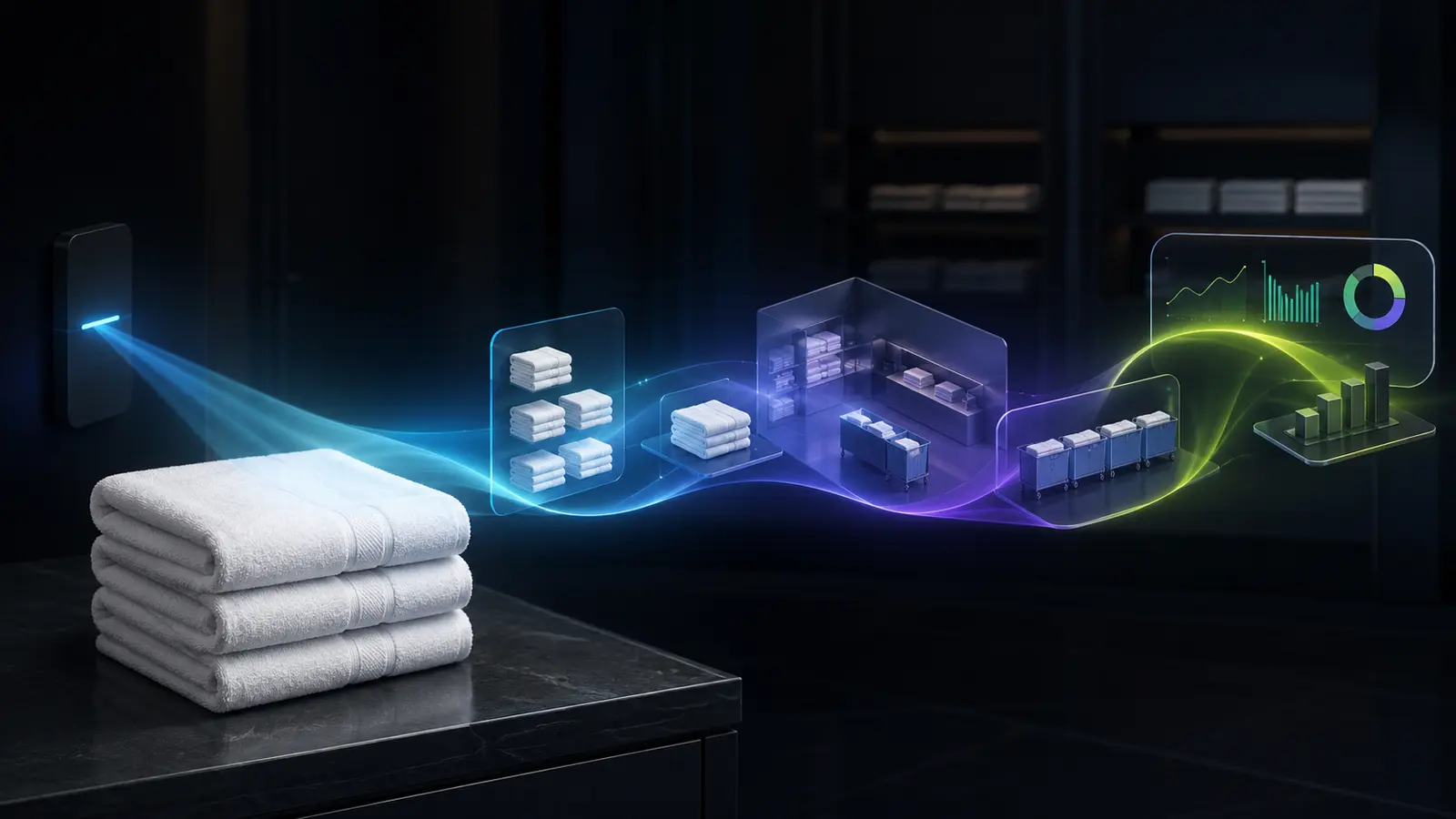
The more ambitious objective is to ask whether the count needs to happen at all. If textiles can identify themselves as they naturally move through the operation, the employee should increasingly disappear from the data-collection process. A trolley passes through a doorway. Textiles leave for the laundry. Clean stock returns. Articles enter or leave a pantry. The physical process itself creates the digital record.
People focus on exceptions
Of course, complete automation is neither possible nor necessarily desirable. There will always be exceptions, damaged articles, unusual movements and situations requiring human intervention. But human attention should be concentrated on those exceptions, not consumed by recording normality. There is another reason this matters.
Every additional manual step is also an opportunity for the information to become incomplete. People forget. Shifts become busy. Procedures are followed differently by different employees. A system that requires perfect human discipline to produce reliable information will eventually discover that hotels are populated by human beings. Good technology should be designed around that reality. The best connected-textile operation may therefore not be the one with the most readers, the most screens or the most impressive scanning procedure. It may be the one employees barely notice.
Textiles move as they always did. Housekeeping works as it always did. Laundry collections and deliveries continue. But quietly, in the background, the operation becomes measurable. That should be the objective. Because the purpose of technology is not to create more work in order to generate better data. It is to generate better data so people can do less unnecessary work.