
Beyond housekeeping
Textiles are usually considered a housekeeping responsibility. That makes perfect operational sense. Housekeeping consumes them, distributes them and collects them and is normally the first department to notice when there is not enough of them. But economically, textiles are much bigger than housekeeping. Procurement selects it and negotiates its price. Finance pays for it, either directly or through a rental or laundry contract. The laundry processes it. Logistics moves it. Operations depend on its availability. Sustainability teams increasingly care about how long it lasts and what happens to it afterwards.
A circulating asset
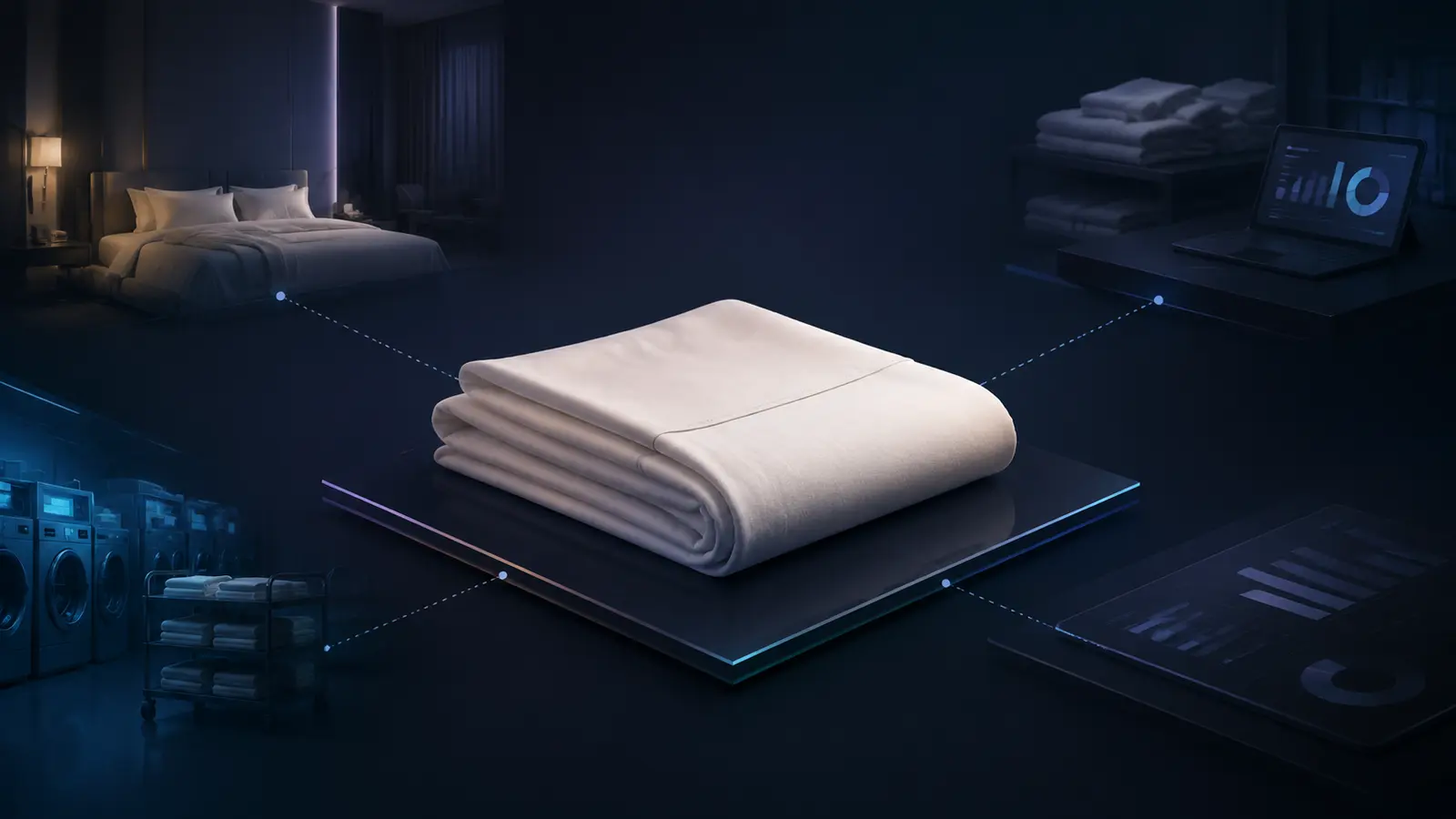
And, ultimately, the guest sleeps in it, dries with it and judges part of the quality of the hotel through it. Perhaps the problem starts with the word consumable. A bathroom amenity is consumed. Once used, it needs to be replaced. Textiles are different. A towel may be purchased once and then move hundreds of times between guestroom, housekeeping, laundry and storage before eventually reaching the end of its useful life. It is much closer to a circulating operational asset.
That distinction becomes even more interesting when the textiles are rented. The hotel may not own the asset at all, but it still consumes the service provided by that asset. It needs the towel to be available, in acceptable condition and at the right moment. And, as we have already seen, it ultimately pays for the amount of textile inventory required to provide that service. Ownership changes. Operational dependency does not. Thinking about textiles as a circulating asset also changes the questions worth asking.
Questions across departments
A consumable is primarily a purchasing question: how much did we buy and when do we need to buy more? A circulating asset creates different questions. How intensively is it being used? How long does it remain outside the hotel? How often does it complete the cycle? How much stock is required to support that circulation? Where does it disappear? How long does it last? Are we replacing it because it has genuinely reached the end of its useful life, or because inefficient management has made replacement necessary?
Suddenly, a towel is connected to Procurement, Finance, Housekeeping, Laundry and Sustainability at the same time. This is also why responsibility can become fragmented. Housekeeping may see shortages. Procurement sees purchase orders. Finance sees invoices. The laundry sees kilograms or pieces processed. Sustainability sees textile consumption and waste. Each department sees a perfectly valid part of the picture, but nobody necessarily sees the complete lifecycle. And problems that cross those boundaries are difficult to solve from inside any one of them.
Manage the complete process
If laundry turnaround deteriorates, Housekeeping experiences the shortage, Procurement may eventually purchase additional stock and Finance pays the bill. If textiles disappear prematurely, Sustainability records greater consumption while the underlying operational cause may remain unknown. The individual decisions can all be perfectly reasonable while the overall result is inefficient. Perhaps hotel textiles therefore need to be managed less as something Housekeeping happens to consume and more as a continuous operational process.
A process that starts with specifying and sourcing the textile, continues through hundreds of movements and uses, and ends only when the article finally leaves circulation. Housekeeping will always be central to that process. But textiles are not simply housekeeping consumables. And treating it as one may be precisely why so much of its true cost remains difficult to see.