
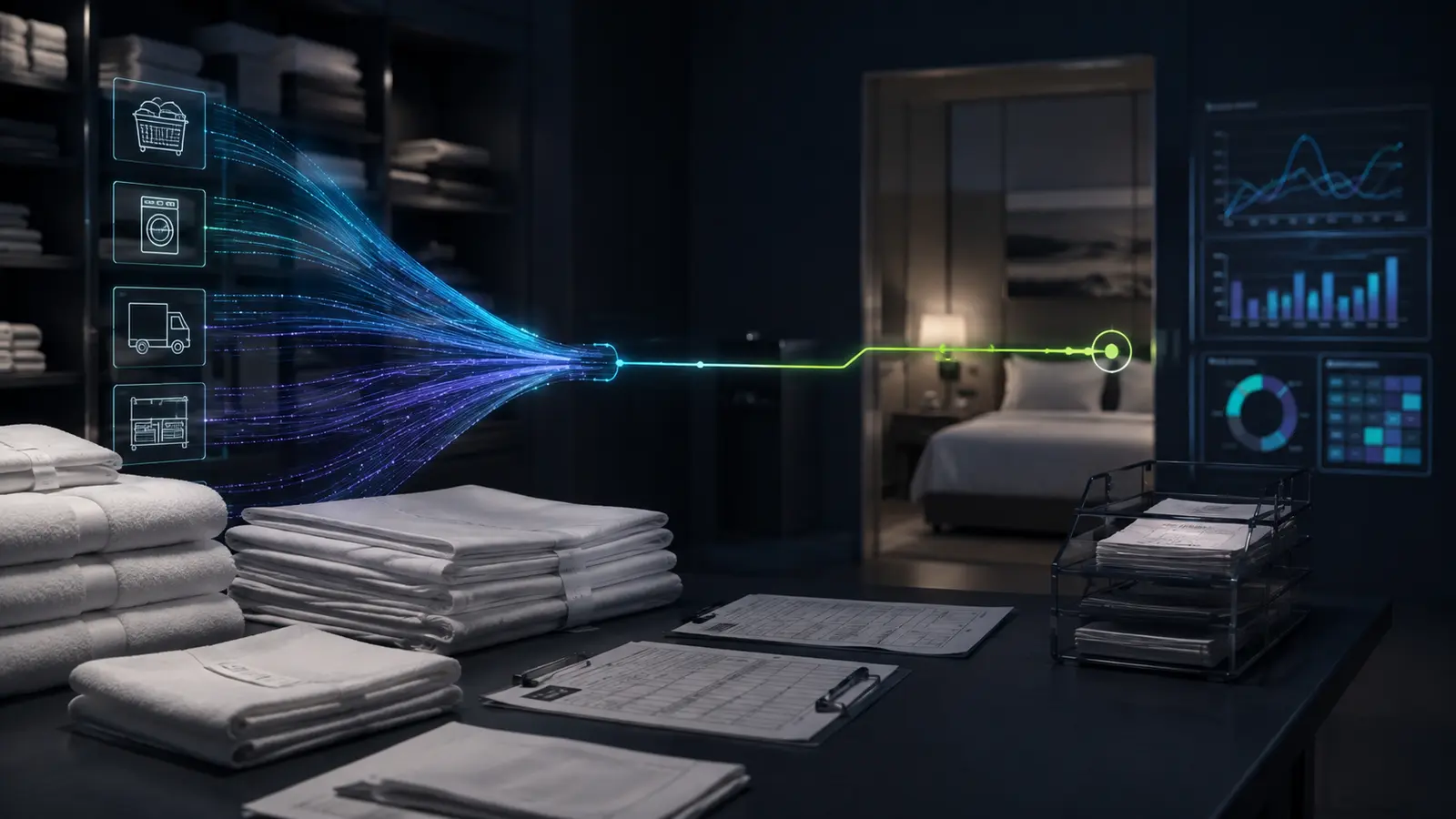
The promise of AI
Artificial intelligence is rapidly finding its way into almost every conversation about the future of hospitality. AI will forecast demand, optimise pricing, improve procurement, automate administration and help managers make better decisions. Inevitably, it is also beginning to appear in discussions about hotel operations and textile management. But there is a fairly basic problem. AI cannot understand an operation that the data itself cannot describe. Imagine asking an AI system how many bath towels a hotel should order for the next twelve months.
To provide a useful answer, it needs considerably more than the current inventory. It needs to understand how quickly towels are being consumed, how that consumption relates to occupancy, how frequently articles disappear from circulation, how long they last, how much stock is tied up in the laundry cycle, what operational buffer the hotel requires and how long replacement stock takes to arrive. If those inputs are estimates, incomplete spreadsheets or annual stocktakes, adding artificial intelligence on top of them does not magically create knowledge. It creates a more sophisticated way of analysing uncertainty.
Building the data foundation
This is why the most important step towards AI in textile management may have very little to do with AI itself. It is creating good operational data. Once that foundation exists, things become much more interesting. A system can recognise that towel consumption is increasing faster than occupancy. It can identify that laundry turnaround has gradually deteriorated. It can notice that one textile type is disappearing significantly faster than comparable articles. It can calculate that current stock is likely to fall below the hotel’s safety level before a normal replenishment order could arrive.
At first, none of this necessarily requires artificial intelligence. Good analytics, sensible rules and reliable data can already achieve a great deal. And perhaps that distinction matters. There is a temptation today to label almost any form of automation or prediction as AI. But the objective should not be to put AI into textile management. It should be to make textile management better. If a simple calculation provides the correct answer, there is little virtue in making it more complicated.
From analysis to action
Where AI becomes genuinely interesting is when the number of variables and relationships becomes too large for conventional analysis to handle comfortably. Why is this hotel’s textile consumption increasing? Is it occupancy, guest profile, housekeeping practice, seasonality, laundry performance or a combination of several factors? Why does the same towel last longer in one property than another? Which apparently unusual movements actually require somebody’s attention?
That is where AI can begin moving the system from reporting information towards interpreting it. And eventually, from interpretation towards recommendation. Not simply: “Your bath towel stock has fallen by 8%.” But: “At the current rate of depletion, your stock is likely to fall below the required operational level in eleven weeks. Your normal supplier lead time is nine weeks. Consider replenishing now.” There is a significant difference between those two messages. One gives the manager information.
The other helps the manager decide what to do. The same principle applies whether the textiles are owned or rented. In a rental model, the recommended action may not be to purchase anything. It might be to investigate turnaround, adjust the textile pool or discuss an emerging requirement with the laundry. The hotel still needs the intelligence because it still benefits from controlling the efficiency of the service it pays for.
Start with trustworthy information
Perhaps this is where the discussion about AI in hospitality sometimes starts at the wrong end. Before asking what artificial intelligence can do with hotel textiles, we should ask whether we have created the information it would need to understand them. Because AI is extraordinarily good at finding meaning in data. It is considerably less good at finding meaning in data that was never collected.